Corporation Tax remains one of the most important compliance areas for UK limited companies. For the 2026/27 tax year, the headline rates remain unchanged, but changes to capital allowances, penalties and filing requirements mean accountants still need to review their Corporation Tax processes carefully.
For CPA firms, accountants and finance professionals managing multiple corporate clients, understanding the rate bands, marginal relief, associated companies and filing deadlines is essential.
Here are the key questions accounting firms should consider.
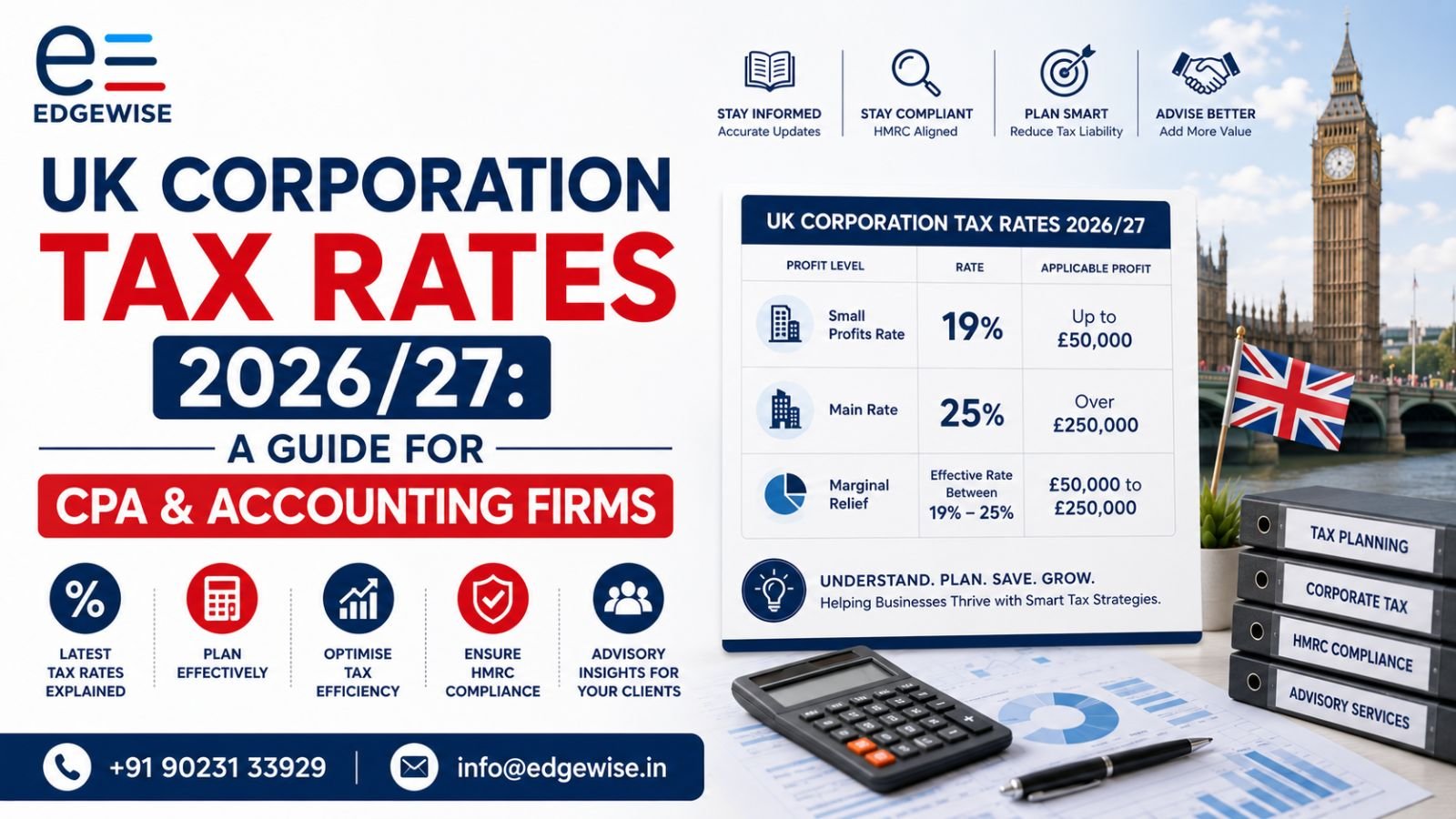
Q1. What are the UK Corporation Tax rates for 2026/27?
The Corporation Tax structure remains:
| Taxable Profits | Corporation Tax Treatment |
|---|---|
| Up to £50,000 | 19% Small Profits Rate |
| £50,001 to £250,000 | Marginal Relief applies |
| Above £250,000 | 25% Main Rate |
These thresholds can be reduced where a company has associated companies.
Q2. What is Corporation Tax?
Corporation Tax is charged on the taxable profits of UK limited companies and certain other incorporated organisations.
Taxable profits can include:
- Trading income
- Investment income
- Certain gains on the disposal of business assets
- Overseas income of UK-resident companies
Companies are responsible for calculating their taxable profits, paying Corporation Tax and filing a Corporation Tax Return, commonly known as the CT600.
Q3. What is the Small Profits Rate?
Companies with taxable profits of up to £50,000 may generally qualify for the 19% Small Profits Rate, subject to the relevant rules.
This allows smaller companies to continue paying Corporation Tax at a lower rate than companies within the main-rate band.
Q4. When does the 25% Corporation Tax rate apply?
The 25% Main Rate generally applies where taxable profits exceed £250,000.
However, accountants should not look only at the company’s standalone profit figure. Associated companies can significantly reduce the thresholds available to each company.
Q5. What is Marginal Relief?
Marginal Relief applies where profits fall between the Small Profits Rate threshold and the Main Rate threshold.
Instead of Corporation Tax immediately increasing from 19% to 25%, the effective tax rate gradually increases as profits rise.
The formula is:
Marginal Relief = (Upper Limit - Augmented Profits) × (Taxable Profits ÷ Augmented Profits) × 3/200
Augmented profits can include taxable profits together with certain exempt distributions.
For accounting firms, accurate calculation of augmented profits is therefore important when determining the client’s effective Corporation Tax liability.
Q6. How do associated companies affect Corporation Tax thresholds?
This is one of the most important areas for accountants to review.
The normal £50,000 and £250,000 thresholds are divided by the number of associated companies under common control.
For example, where there are two associated companies:
- £50,000 becomes £25,000
- £250,000 becomes £125,000
A client with £100,000 of profits may therefore be much closer to the 25% Main Rate than they expect.
Accountants should therefore always ask whether the client has:
- Other trading companies
- Holding companies
- Subsidiaries
- Companies under common control
- Other connected corporate interests
Q7. What is changing for Corporation Tax in 2026/27?
Although the headline 19% and 25% rates remain unchanged, several changes may affect tax computations.
Writing-Down Allowance
The main-pool Writing-Down Allowance is stated to reduce from 18% to 14% from 1 April 2026 for companies.
Where an accounting period overlaps this date, a hybrid rate may need to be calculated.
New 40% First-Year Allowance
A new 40% First-Year Allowance also applies to certain qualifying plant and machinery expenditure from 1 January 2026.
The relevance of these allowances will depend on the business, the nature of the asset and whether other capital allowance reliefs are available.
Q8. Is Making Tax Digital being introduced for Corporation Tax?
Making Tax Digital for Corporation Tax has been cancelled.
Companies will therefore continue to file their annual CT600 in the normal manner rather than having a Corporation Tax-specific quarterly digital reporting requirement.
This does not affect the separate MTD rules for VAT or Income Tax Self Assessment.
Q9. What are the penalties for filing a CT600 late?
Fixed penalties for late Corporation Tax Returns increase for filing deadlines falling on or after 1 April 2026.
The penalties described include:
- 1 day late: £200
- 3 months late: Additional £200
- Higher fixed penalties for repeated late filing
- Additional tax-geared penalties where returns remain outstanding for longer periods
Importantly, a penalty can apply even where the company has no Corporation Tax liability.
For accounting firms managing large CT600 portfolios, strong deadline monitoring is therefore increasingly important.
Q10. When must Corporation Tax be paid?
One of the most common client errors is confusing the payment deadline with the filing deadline.
For companies that are not required to make quarterly instalment payments:
- Corporation Tax is generally due 9 months and 1 day after the accounting period ends
- The CT600 is generally due 12 months after the accounting period ends
Larger companies may be required to make Corporation Tax payments by instalments.
This means the tax often has to be calculated and paid before the Corporation Tax Return itself is due.
Q11. What common Corporation Tax errors should accounting firms watch for?
Several recurring errors are worth watching for.
Marginal Relief errors
Using taxable profits rather than the correct augmented-profit figure can result in an incorrect tax computation.
Missing associated companies
Failing to identify an associated company can lead to thresholds being overstated and Corporation Tax being underestimated.
Capital allowance errors
Accounting periods spanning changes in allowance rates may require specific calculations rather than simply applying one rate throughout the year.
A structured year-end checklist can help accountants identify these issues before the CT600 is finalised.
Q12. Is Corporation Tax the same as Companies House compliance?
No.
Corporation Tax compliance with HMRC is separate from a company’s statutory filing obligations with Companies House.
Similarly, PAYE and National Insurance relate to payroll liabilities rather than Corporation Tax on company profits.
A company can therefore be compliant with one filing obligation while still being late or incorrect on another.
Q13. Can Corporation Tax compliance create advisory opportunities?
Yes.
Corporation Tax work can move beyond simply preparing and filing the CT600.
Relevant areas include:
- Capital allowance planning
- Reviewing associated companies
- Marginal Relief calculations
- R&D-related considerations
- Timing of qualifying expenditure
- Tax-band planning
These areas can allow accounting firms to move from a compliance-only relationship towards broader tax and financial advisory discussions with their clients.
Why Choose Edgewise for Corporation Tax Support?
Managing Corporation Tax across multiple clients involves more than entering figures into a CT600.
Accounting firms need accurate financial records, reconciled balances, properly prepared working papers and sufficient capacity to complete reviews before deadlines.
Edgewise Training Solutions Pvt Ltd can support UK accounting practices with structured back-office accounting and Corporation Tax preparation assistance, helping internal teams manage routine work while retaining control over technical review and final filing.
Q14. How can Edgewise support accounting firms?
Depending on the agreed scope, Edgewise can assist with areas such as:
- Bookkeeping and ledger preparation
- Bank reconciliations
- Accounts preparation support
- Corporation Tax computation support
- CT600 preparation assistance
- Review of related company information
- Capital allowance schedules
- Supporting schedules and working papers
- Accounting data reconciliation
- Preparation of review-ready client files
This can reduce the amount of routine preparation work performed by partners and senior accountants.
Q15. Why can offshore support be useful during Corporation Tax season?
Corporation Tax workloads can become difficult when multiple client deadlines fall within the same period.
An offshore support model can provide additional capacity for:
- Preparing draft accounts
- Reconciling balances
- Preparing tax schedules
- Identifying missing information
- Organising supporting documents
- Preparing files for senior review
A typical workflow may look like:
Client Records → Bookkeeping & Reconciliation → Accounts Preparation → Corporation Tax Working → UK Accountant Review → CT600 Filing
The UK practice therefore retains responsibility for the technical decision-making and final submission while routine processing is supported offshore.
Q16. Why Edgewise?
Additional Capacity
Edgewise can provide support during busy CT600 filing periods without requiring the accounting practice to immediately expand its permanent team.
Review-Ready Work
Structured preparation and reconciliations can help senior accountants spend more time reviewing rather than rebuilding incomplete files.
Better Use of Partner Time
Partners can focus on:
- Tax planning
- Client discussions
- Complex Corporation Tax issues
- Advisory work
- Business development
instead of spending significant time on routine processing.
Support for Existing Accounting Processes
Edgewise can operate within the firm’s established systems, procedures and review framework.
Scalable Back-Office Support
As a practice grows, additional processing capacity can be added to support increasing numbers of accounts and Corporation Tax engagements.
Final Thoughts
For 2026/27, the headline UK Corporation Tax structure continues to centre on the 19% Small Profits Rate, Marginal Relief and the 25% Main Rate. However, associated companies, capital allowance changes, filing penalties and separate payment deadlines mean the calculation is not always straightforward.
For accounting firms managing multiple corporate clients, the strongest approach is to combine technical Corporation Tax knowledge with accurate bookkeeping, structured working papers and early deadline management.
Note: Corporation Tax rates, allowances, associated-company rules and filing requirements should always be checked against current HMRC guidance before advice or returns are finalised.
Edgewise Training Solutions Pvt Ltd can support this process by providing back-office accounting and Corporation Tax preparation assistance, helping UK accounting firms increase capacity while allowing their senior professionals to focus on technical review, advisory work and client relationships.